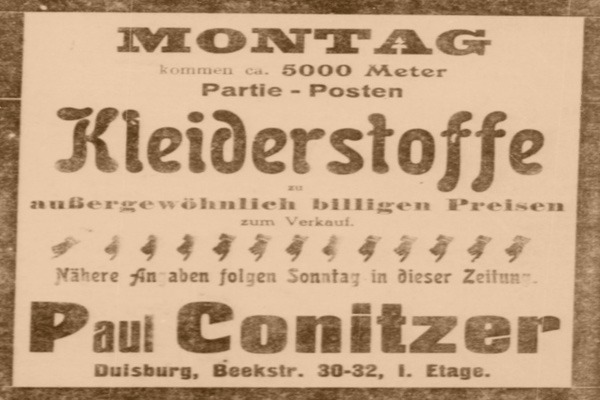
“Dad, you promised us a continuation of the story of Lina and Paul Conitzer. It’s about time now,” says my daughter. We are sitting at dinner and I say: “True. But first, we have to visit Grandma.”
We take a short walk with my mother. She tells us a story. Her eyes shine, and now she stops, grabbing my arm. “That fabric. So wonderful! So soft. In purple. That’s exactly my color. And golden threads were woven into the fabric,” she says, and for a moment it almost seems to me as if she would leave the rollator behind and dance around it with light steps. “You know, it was a closeout lot, and I had to buy it immediately. My neighbor then made a dress out of it,” she continues enthusiastically. “It was such a beautiful dress.” She grips the rollator firmly again, finishing our short walk while murmuring “really beautiful dress”. My mother would have been a regular customer at Paul Conitzer’s shop. Closeouts and bargains have always been a good business model in Germany. At Paul Conitzer’s, there were constantly new offers, announced in the local newspapers, see . In this advertisement on October 7, 1912, in the Rhein- und Ruhrzeitung, he describes his own principle of selling good goods very cheaply.
Due to my low business expenses on the 1st floor, I sell good goods very cheaply. Within a few years, this principle has made my business one of the largest of its kind in Rhineland and Westphalia.
Source:
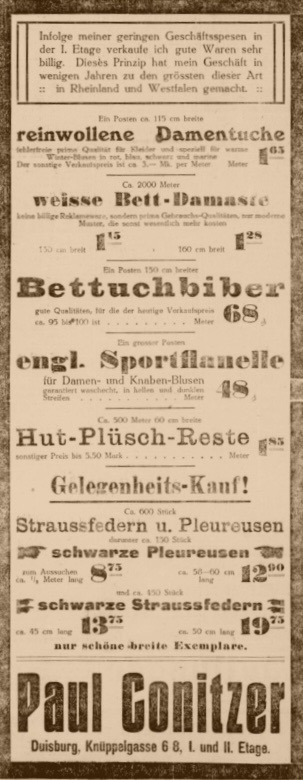
Advertisement Paul Conitzer Knüppelgasse 6-8, see
Paul Conitzer achieved great success in Duisburg with this business model. 15 years after his greatest defeat, the bankruptcy in Bromberg, see , this success was certainly a source of great satisfaction for him. Paul Conitzer was born in Jeschewo, West Prussia. He grew up there along with eight siblings, 16 cousins, three merchant shops, two uncles, and a grandfather. The predominant career aspiration among the boys was to become a merchant. In 1882, his cousins Nathan, Alexander, and Hermann, along with their father, founded a department store in Marienwerder and introduced the “cash system” (Baarsystem) . Paul and his brother Alexander put their heads together in Jeschewo and came up with the idea to copy the concept. They moved to Bromberg, founded a shop on November 4, 1889, and named it “O. Conitzer Söhne”, see .
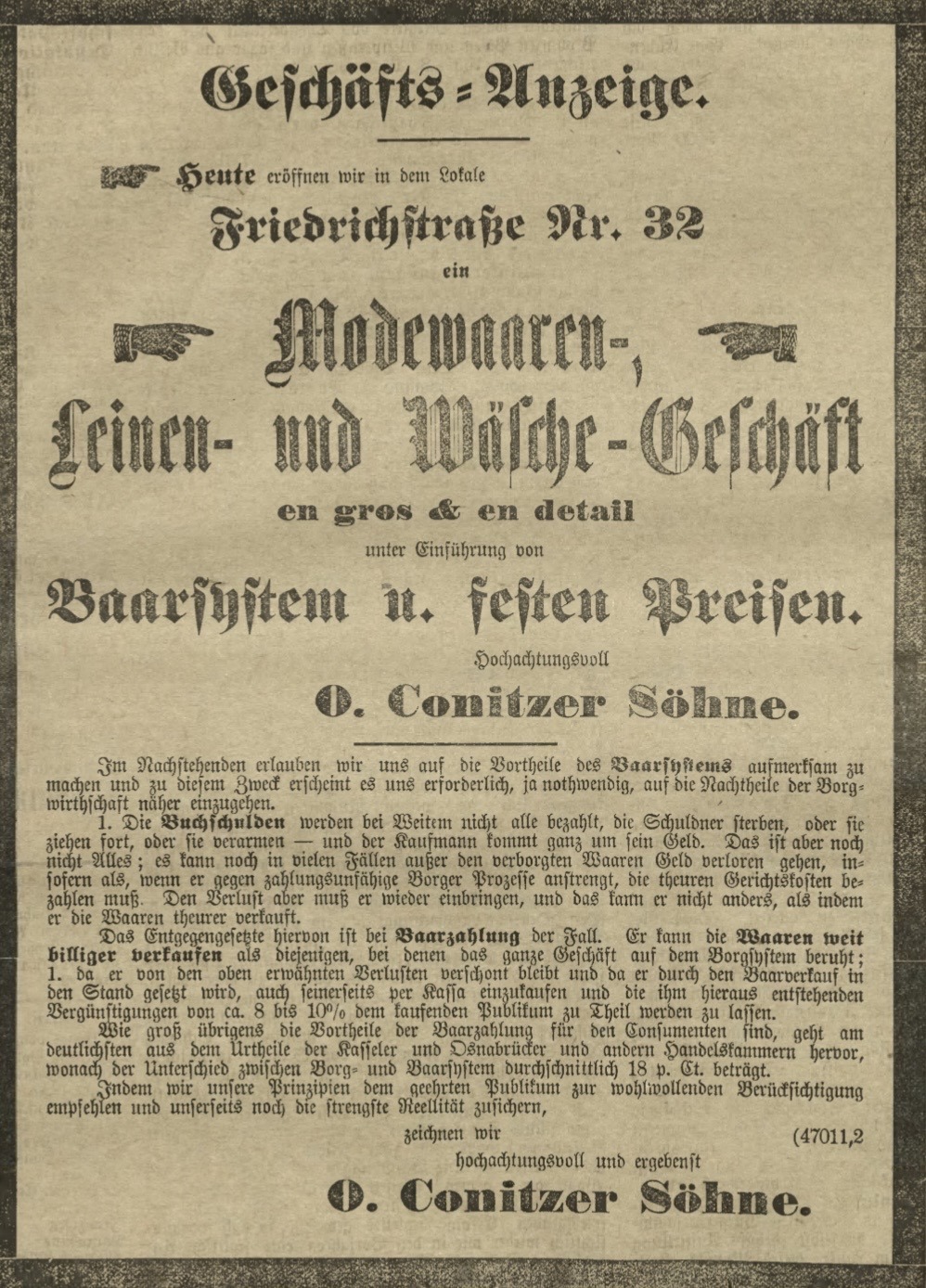
Advertisement opening of O. Conitzer in Bromberg, see
The name of the department store changed from O. Conitzer Söhne to Gebr. Conitzer on November 16, 1889, see . Thus, the shop changed its name just two weeks after opening. Did the brothers disagree about the Name? Or did the cousins from Marienwerder contact Paul and Alexander Conitzer? The fear of confusion with their department store in Marienwerder, whose name M. Conitzer & Söhne differed by only two letters, might have been significant. Unfortunately, the Gebr. Conitzer department store went bankrupt two years later, see . Whether the people of Bromberg did not like the new “cash system” or simply needed more time to get used to it is hard to judge. In any case, unlike Moses, Oser Conitzer could not help his two sons with a large amount of starting capital. The money in Oser Conitzer’s family was enough to make a living. Unfortunately, financing a business exceeded Oser Conitzer’s financial means. Moreover, he had a total of nine children, all of whom had to be provided for equally. What weighed heaviest, however, was that he died on February 9, 1889, see . In a letter to Hilde Conitzer, a granddaughter of Oser Conitzer and daughter of Alexander Conitzer, John Henry Richter2 mentions this money circumstance.
… our grandparents and great-grandparents Conitzer “brought through” or “raised” 8 or more children, and Oser certainly never had much money either, but he made his living.
Source:
In Duisburg, Paul Conitzer’s closeout concept was a huge success. The lookalikes of my mother bought and bought, because there were so many dreams that Paul Conitzer could fulfill with his closeout goods. The women could stroll through the Duisburg department stores, such as Alsberg or Cohn & Epstein. Inspect the new dresses. They had to figure out the patterns and then, when the time came and the fabric was finally on sale at Paul Conitzer’s, they had to strike. At home, they sewed late into the night, and then, presto, a new dress was created. On June 2, 1913, Paul Conitzer was able to open a new and, above all, larger shop at Beekstrasse 30-32.
I want to and can continue to sell cheaply in my new premises, in some cases even cheaper than before – because I have space to showcase my huge inventory and utilize it better than before.
Source: Advertisement opening Paul Conitzer Beekstrasse 30-32, see
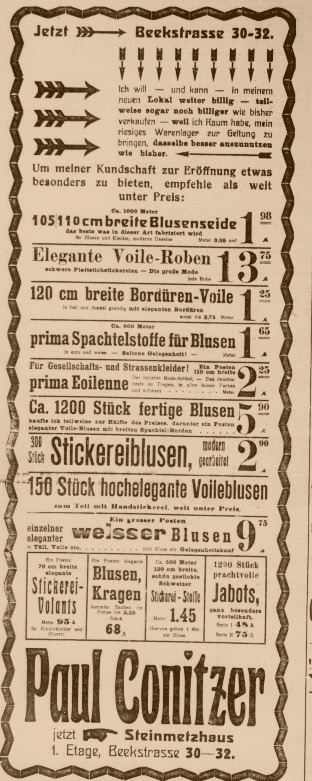
Advertisement Paul Conitzer opening Beekstrasse 30-32, see
The shop at Knüppelgasse 6-8 was not abandoned but converted into a millinery shop. “Putz” (finery) was the term used at the time for fashionable ladies’ hats, without which one would not leave the house on Sundays. The word “putzen” had evolved from its original meaning of removing dirt and now meant dressing up, i.e., dressing beautifully. You could dress very beautifully with a hat, which is why hat shops were called millinery shops (Putzgeschäfte)3. During the war years from 1915 onwards, Paul Conitzer mainly offered mourning hats in his advertisements. Unfortunately, shortly after the war, the family needed a set of mourning hats themselves.
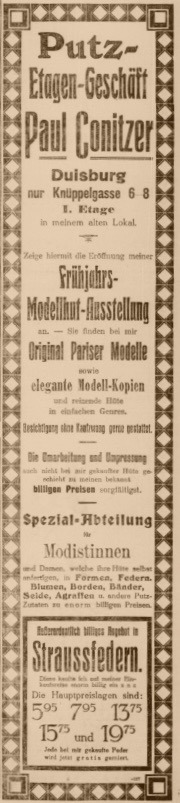
Advertisement millinery shop Paul Conitzer opening Knüppelgasse 6-8, see
On July 6, 1919, Paul Conitzer died of a stroke. He was 52 years old. He left behind a wife, two sons aged 16 and 13, and two shops. Lina Conitzer became once again the sole shareholder of the company. The name Paul Conitzer was retained. The businesses continued to run. It was certainly a shock for everyone, especially for Lina, who lost her beloved husband with whom she had lived her dream of owning a shop. She was a bookkeeper and he was a merchant. The result of their cooperation was two well-running shops in downtown Duisburg.
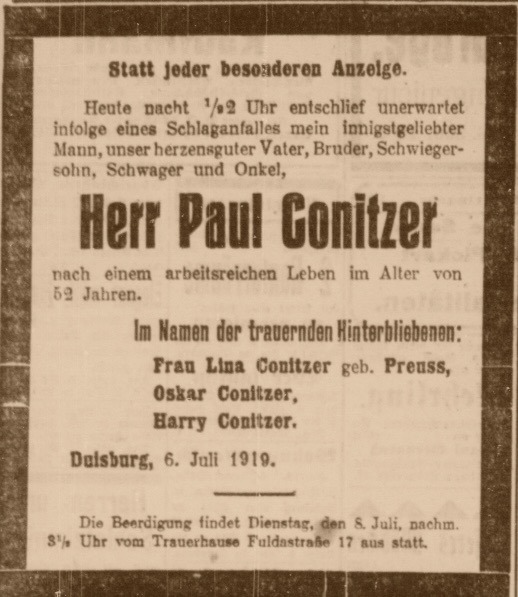
Image: Obituary Paul Conitzer, see
“Dad, and what happened to Lina then?” – My daughter looks at omission. I think for a moment. “She won’t give up. Her life will remain a roller coaster ride,” I say. “Dad,” says my daughter, “this time you mustn’t make us wait so long for the continuation.”
Family tree: Aron Israel Conitzer | Oser Conitzer | Paul Conitzer and Lina Conitzer
Footnotes:1 Cover image source: See . 2John Henry Richter was a librarian, including at the “Library of Congress” in Washington, and he was the genealogist of the Conitzer family. He left behind a very large collection of letters and collected sources at the Leo Baeck Institute. His grandmother Martha Segall was née Conitzer. Her father was Oser Conitzer. We are trying to find our way in his large footsteps. 3A very interesting blog on the subject of milliners and ladies’ finery can be found on this page .
Sources: