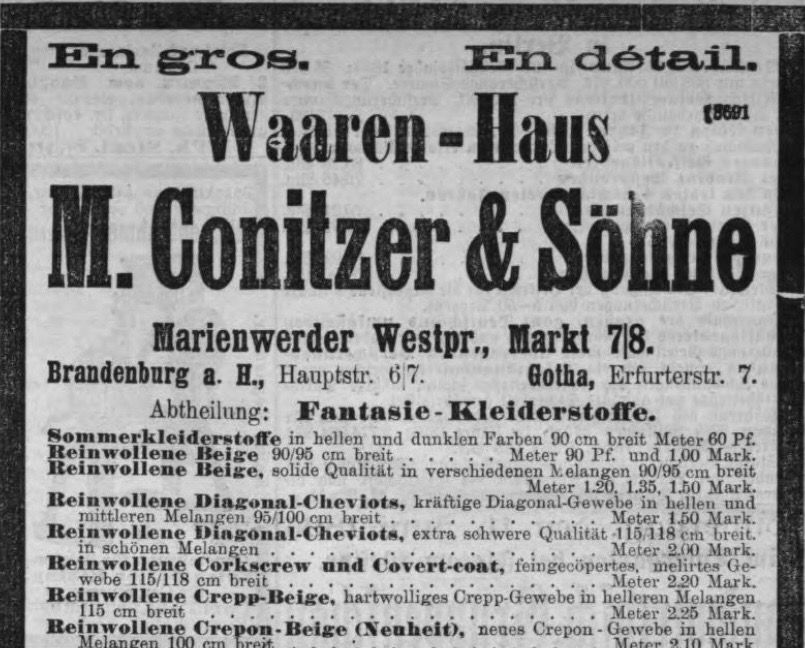
The result was sobering. The figures stood in columns below and beside one another, and the sum of the first year’s income for their new department store in Marienwerder stood in black and white below the line. The brothers were disappointed. They had all already double-checked the math several times. The figure was correct, but unfortunately, it was too low. They would have to talk to their father. This project had to be aborted. Only would their father not be reasoned with; what had to be aborted here was definitely not the business, but this conversation. Giving up was not an option for Moses Conitzer. No matter how much Nathan and Alexander struggled, their father could not be convinced. On the contrary, he was in a very good mood and looking forward to the next year. He did not worry about his pension. He had written his pension into the business contract when he gave his sons the money to open the department store. It must have happened like that, as described in the autobiography of Rudolf Conitzer [1].
The Conitzer family department store in Marienwerder was opened on February 1, 1882, under the name “Kaufhaus M. Conitzer & Söhne” [4]. It was founded by the father, Moses Conitzer, and his sons Nathan and Alexander. With the opening of the department store, they introduced the “Baarsystem” (cash system). This system was destined to change shopping in Marienwerder and throughout the German Empire forever. In the department stores and shops in Marienwerder, customers could buy on credit. This was common in almost all shops in the German Empire. The amount was entered into a thick book and could be paid back in installments. The price of the goods was negotiable; thus, a wealthy landowner might get a better price for a lady’s hat because the salesman knew his wife changed the trimmings, called „Putz“, on her hat more often. “Putz” was the term used at the time for the trimmings on a lady’s hat.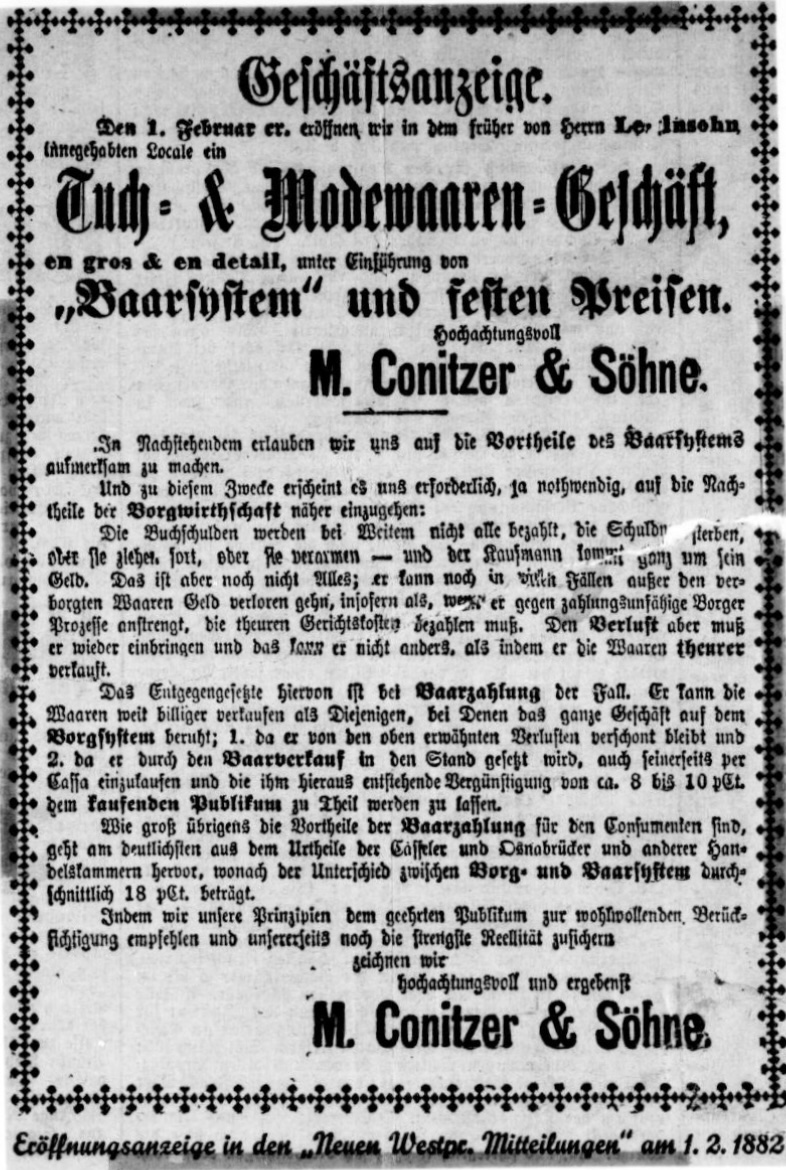
Figure 1: Advertisement for the opening of M. Conitzer & Söhne Marienwerder on February 1, 1882 (Source: [2])
The “Baarsystem” worked as follows: Prices were fixed and non-negotiable. The price for a lady’s hat with trimmings, for example, applied equally to the maid, the surveyor, or the landowner. Inspecting the lady’s hat beforehand to determine its quality was explicitly permitted. For this purpose, particularly well-lit salesrooms were provided. The trimmings for the hat did not have to be bought immediately if the wages for the week weren’t enough because the husband had already invested the money in beer. However, once the decision to buy the hat was made, it had to be paid for in cash. If the wife decided to buy the trimmings, they could be exchanged if her best friend didn’t like them at all because they were no longer in fashion. There was a large selection of trimmings in the department store, as the factory supplied the M. Conitzer & Söhne department store with various types, such as ostrich feathers or silk ribbons in large quantities, and M. Conitzer & Söhne paid in cash. Through the “Baarsystem,” the department stores were able to reduce the price compared to specialty shops (compare Figure 1, where 18% is mentioned).
Figure 2: First M. Conitzer & Söhne department store in Marienwerder, Marienburger Str. 1 (Source: [4]), building on the far right of the image
The citizens got used to the “Baarsystem” or had to be “educated” to it [3]. Later, Moses Conitzer confessed to his sons that he had taken 6,000 Reichsmarks from the till in the first year; this sum was intended to serve as a security. This is also stated in Rudolf Conitzer’s biography [1]. The department store was so successful that only four years later, in 1886 [4], the family built a new, modern department store. This store was designed to meet all the requirements of a modern department store. Large shop windows were installed, the various floors were accessible via elevators, and the rooms were heated by central heating. The old building at Marienburger Strasse 1 subsequently served exclusively for the sale of men’s and women’s clothing. It was managed by Hermann Conitzer [4].

Figure 3: Second M. Conitzer & Söhne department store, Marienwerder, Am Markt 7 and 8 (Source: [4]), building on the far right of the image
Today, the “Baarsystem” is a common practice. At that time, however, it was standard practice to negotiate the price of goods and buy on credit. The “Baarsystem” was therefore an innovation and a novelty for customers. Initially, the Jewish department store owners had to do a lot of convincing. They alone bore the risk of introducing the new system, but they were convinced of the advantages and were proven right. The “Baarsystem” prevailed and works today exactly as it did back then.
Quellen:
- „Mein Leben – Selbstbiographie“, Rudolf Conitzer, 1929/30, Berlin, Link:https://links.cjh.org/primo/lbi/CJH_ALEPH000200579
- John H. Richter Collection, Identifier: AR 1683 / MF 534, John Henry Richter (1904–1994), Leo Baeck Institute, Box 6, https://archives.cjh.org/repositories/5/resources/11136
- Walter E. Schulz: Der Conitzer-Konzern und seine Anschlusshäuser. In: Industrie-Bibliothek, Die Illustrierte Zeitschrift der deutschen Wirtschaft, 4. Jahrgang 1928 (Band 31), S. 54–68. (OCLC 990313861)
- Wikipedia – M. Conitzer & Söhne, Link: https://de.wikipedia.org/wiki/M._Conitzer_%2526_S%C3%B6hne
- Ursula Töller, M. Conitzer & Söhne – Ein jüdischer Warenhauskonzern, 2025, Nomos Verlag, ISBN 978-3-7560-3062-0
- Kwidzyn Museum, Kaufhäuser – M. Conitzer & Söhne, Łukasz Rzepczyński, Link: https://kwidzyn-muzeum-lukasz.blogspot.com/2012/02/m-conitzer-sohne-cz-1.html
Weitere Geschichten der Familie Conitzer …
Day 1 – Tour of Poland: In Bydgoszcz, we visit the site where the M. Conitzer & Söhne department store once stood.
Department store Paul Conitzer in Duisburg or the enchantment of women
Lina Conitzer: Bazaar for Bargain Lots or Women’s Equality
Rudolf Conitzer – a founder of the 19th century
Moses Conitzer and his sons