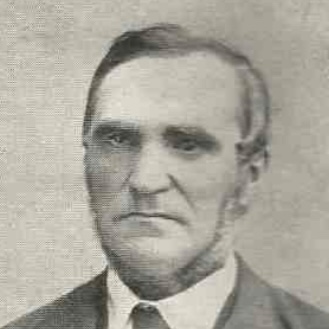
The train clattered and jolted. Moses Conitzer and his son Rudolf sat in the fourth class carriage on bundles of packing canvas they carried to wrap their goods. They were on their way to the trade fair in Frankfurt an der Oder to purchase new goods for their shop. Fourth class was the cheapest class on the Prussian railway. It resembled a freight car more than a passenger train. There were no compartments and no seats. Perhaps Rudolf was talking—enthusiastic about the new inventions of the industrial age, discussing what opportunities these changes might bring for their own business. Or perhaps they were silent, dreaming of the future: newspaper advertisements for upcoming special offers, low prices, many new customers. Father and son would later prove crucial to the success of M. Conitzer & Sons. Their frugality was a cornerstone in making this enterprise successful.
Move to Jeschewo
Moses Juda Conitzer was born in 1820 as the fourth child of Aron Israel in Zempelburg, West Prussia. Together with his younger brother Alexander, he settled in the village of Jeschewo in 1848 and founded a manufactory shop. It was a shop offering all goods needed in the village and its vicinity. Jeschewo lies 70 km from Zempelburg.
When Moses married Ernestine Bennheim in 1850, his brother Alexander moved out and founded a new shop with the youngest brother, Oser. When Alexander married, Oser moved out and founded the third business. Moses had seven children, Alexander nine, and Oser also nine; in addition there were the wives and the grandfather. Soon, 32 Conitzers lived in Jeschewo and there were three manufactory shops [2].
Allegedly, the competition did not lead to disputes within the family. This family cohesion would become the second cornerstone of the later success of the department store group.
The New House
The first house in Jeschewo soon became too small for the growing family, and a new house had to be built. According to the autobiography of Rudolf Conitzer [1], disputes now arose within the village. The long-established Polish residents tried to prevent the building permit by spreading the rumor that Moses did not have enough money to build.
To prove his financial reserves, Moses purchased a second plot of land next to the first. The building permit could apparently not be prevented, so the Poles financed an inexpensive house for Moses’ neighbor, built very close to the boundary of the new property, further complicating construction.
Nevertheless, Moses built the new house in 1857, and the family continued to grow. In addition to the three existing children—Rudolf, Sara, and Rahel—four more were born: Nathan, Alexander, Hermann, and Lothar.
A prayer room was set up in the new house, which greatly simplified life on Jewish holidays. Moses’ father, Aron Israel Conitzer, led the prayers. Customers attended services in Moses Conitzer’s house and later shopped in the manufactory store. As this example shows, giving up was clearly not an option for the Conitzers—another trait that would soon prove highly advantageous.
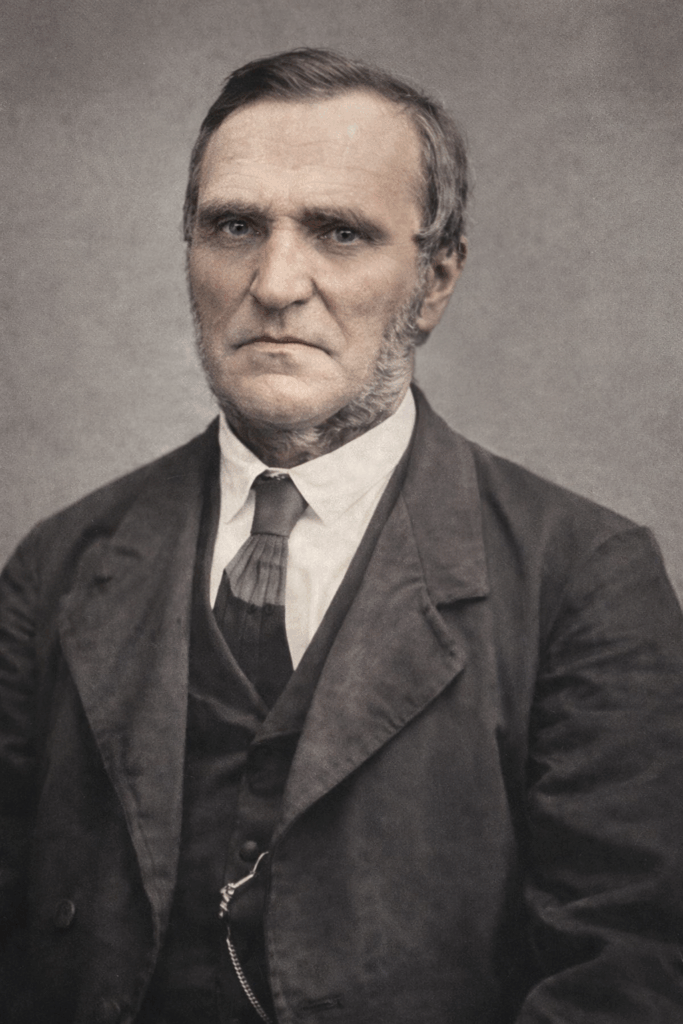
Digitally restored image: Moses Juda Conitzer, founder of M. Conitzer & Sons
Railway Construction
In Prussia, the Industrial Revolution continued. Factories were built, as well as transport routes from factories to cities and ports. Goods and raw materials had to be transported efficiently. Although Jeschewo was a village, these developments affected its people—especially Moses.
The Prussian Eastern Railway line from Bromberg to Königsberg ran near the village. During construction, many workers were needed and earned good wages. Part of this money flowed into the manufactory shop, allowing Moses Conitzer to profit from industrial development as well.
He expanded his business, founded an agricultural operation, and built another rental house. In these years, West Prussia was exceptionally free of war. Under Prussian leadership, the German Empire was born [6]. In the wars of German unification, it defeated Denmark in 1864, Austria in 1866, and finally France in 1871 [6].
The Kingdom of Prussia transformed a patchwork of principalities into the German Empire. This transformation and sense of new beginnings were felt everywhere. Tariffs were dismantled, markets opened, and there was an overall economic upswing, supported by reparations from France.
This change was also felt in Moses Conitzer’s wallet—it grew. With the profits from his manufactory shop, he earned enough to enable his sons Nathan, Alexander, and Hermann to found their own business in 1882. In return, he was to receive only a small pension, which he likely received punctually for the rest of his life.
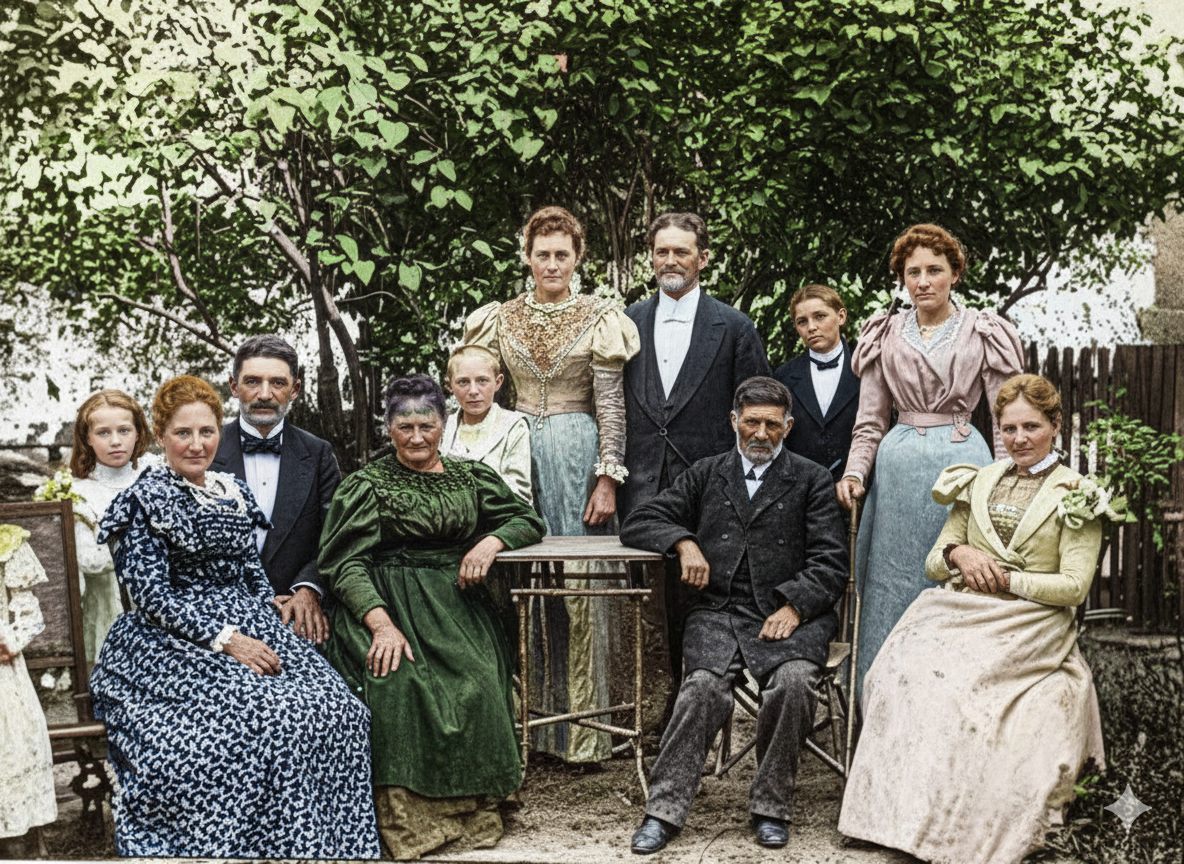
Digitally restored image from the engagement celebration of Alexander Conitzer and Daja Dorothea Müller around 1890 in the garden of Moses and Ernestine Conitzer. From left to right: Herta Conitzer (later Davis), Sara Flatauer (née Conitzer), Lesser Flatauer (?), Ernestine Conitzer (née Bennheim), Bruno Marcus, Daja Dorothea Müller, Alexander Conitzer, Moses Conitzer, Arthur Marcus, Ernestine Bieber, Rahel Marcus (née Conitzer). From the John Henry Richter collection.
M. Conitzer & Sons
It was to become a modern department store. Rudolf had already founded his own store in Schwetz in 1878. Nathan trained in Osnabrück and brought back innovative ideas, which Rudolf tested in Schwetz.
Goods were now paid for in cash only; buying on account was no longer possible. Goods could be viewed and tried on, and even returns were accepted if customers were not satisfied. With this new concept, merchants across the German Empire founded department stores modeled after those in major metropolises such as London, Paris, and New York.
The Wertheim family opened their first department store in Stralsund in 1875, Rudolph Karstadt in Wismar in 1881, and Hermann Tietz in Gera in 1882. Jeschewo was too small for this development, so the family moved on to Marienwerder, a small town south of Danzig.
There, in 1882, they founded the first department store M. Conitzer & Sons [5], becoming part of the early history of department stores in Germany. Moses provided the capital and the “M” in the name. The three sons—Nathan, Alexander, and Hermann—contributed the second part of the name, the idea, and its execution. Father and mother helped behind the counter.
Two decades later, the group would encompass 22 department stores throughout Germany [4].
Moses Conitzer died on February 5, 1902, in Marienwerder and is buried in the city’s Jewish cemetery [3].
About The Author
