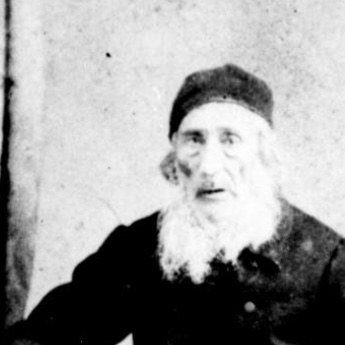
In his retirement, Aron lived with his son Moses in Jeschewo, where his countless grandchildren lived, the children of Moses, Alexander, and Oser. He liked to entertain them especially on winter evenings by the warm fireplace. He particularly liked to repeat the story from the time of the French occupation of Zempelburg [1]. As a courageous and respected citizen, he was given the task of forming a citizens’ militia. He instructed the new soldiers in military discipline. Marching was practiced in particular: forward, backward, sideways. In one exercise, the soldiers were supposed, after marching a few steps forward, to skillfully complete the drill with a backward movement. After the first step backward, only the slippers were standing in precise military formation, while the soldiers themselves were standing barefoot and quite unmilitary on the parade ground. The laughter of the grandchildren and adults echoed through the house and out into the street.
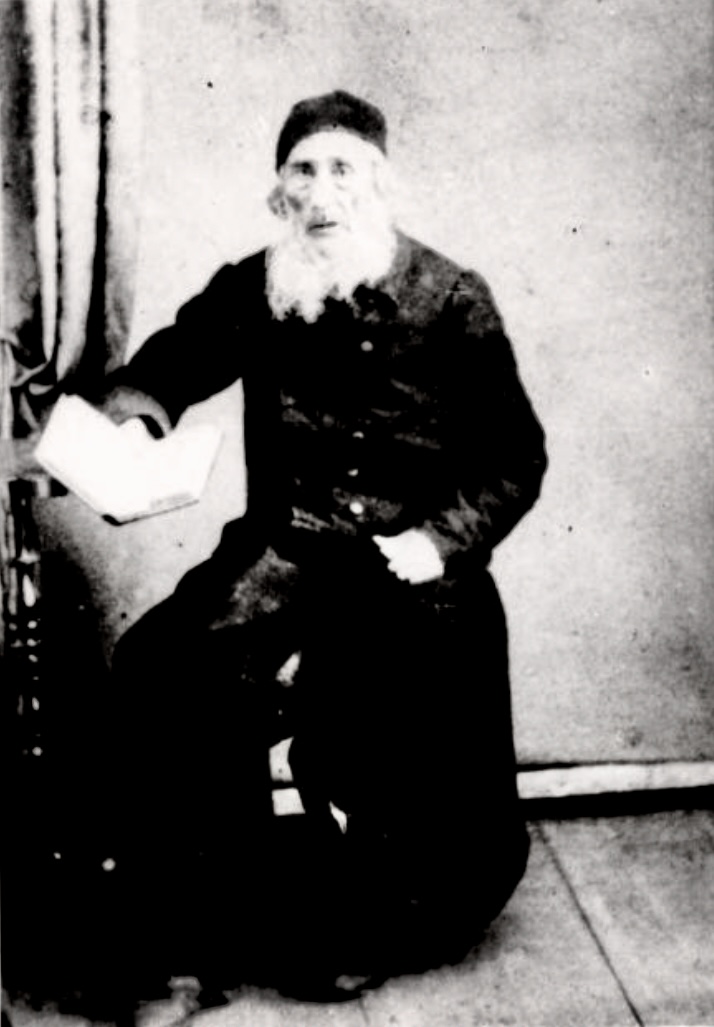
Aron Israel Conitzer [3]
Early years
Aron was born in 1789 near Warsaw in the Kingdom of Poland [2]. Also in 1789, the bourgeois revolution in France led to the deposition of the king [7]. The impact of this revolution would later become important for Aron’s life. For now, however, we are still in the Kingdom of Poland, which, together with Lithuania, ruled large parts of Eastern Europe from 1569 to 1795. Compared to its neighbors Russia and Prussia, Poland-Lithuania steadily lost power and influence. Poland had to be partitioned a total of three times. Aron was just five years old when the Kościuszko Uprising [5] against the Russians for a united Poland failed in 1794 and Poland was partitioned for the third time [5].
At that time, General Suvorov’s army was besieging Warsaw, which was being defended by Kościuszko’s army. It is probable that during this turbulent period, Aron’s father was killed by General Suvorov’s plundering Russian army [4] or died as a soldier in Kościuszko’s army. There were also regiments of Jewish soldiers, and Kościuszko promised to fight for all Poles [10]. John Henry Richter recorded 1792 as the year of death in the family tree. I have not yet found a primary source for this; what we know for certain is that he was still alive before Aron’s birth. Later, Aron grew up alone with his mother in Zempelburg, as his father had been murdered. Zempelburg was located in the Kingdom of Prussia and had a high number of Jewish citizens compared to other surrounding towns [6]. Aron called himself Aron Israel Roheme after his mother [1], which was a Jewish tradition.
French Occupation
When Aron was a young adult, the French came to Zempelburg. He had already established himself as a merchant, as another anecdote from the biography of Rudolf Conitzer shows: Aron traded in silk ribbons. A French soldier took the silk ribbons from him in order to give them to a pretty girl [1]. Aron complained, took the ribbons back from the soldier, and apparently was then given the task of founding the citizens’ militia so that silk-ribbon theft could be prevented in the future — perhaps also to protect Prussian girls from the “silky’ Frenchmen. Unfortunately, we do not know this for certain.
How Aron Israel became a Conitzer
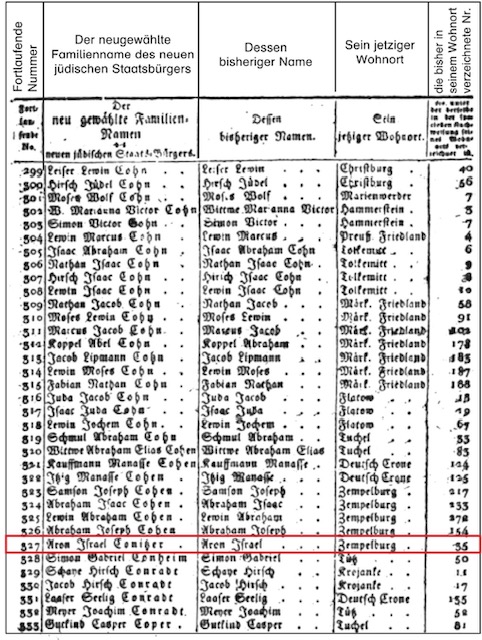
Page from the alphabetically ordered list of the newly chosen family names of Jewish citizens in West Prussia [3], from the book ‘The Jewish Merchant Family Conitzer – Traces of Jewish Life in Tangermünde’ by Petra Hoffmann [8].
His life
In 1816, Aron Israel Conitzer married Genendel Kalenscher. They had seven children: Rahel, Flora, Israel, Moses, Alexander, Salomon, and Oser. Genendel died shortly after the birth of the youngest son, Oser, so that he and the other younger siblings had to be raised by the eldest daughter, Rahel. Aron was first a merchant [2]. Later, Aron was mainly concerned with his Jewish faith and founded a religious school. He wrote and repaired Torah scrolls [2]. Thus, he evolved from the worldly to the spiritual. In old age, when he lived with his son Moses, he held devotions on high holidays in a room of the large house that was furnished for worship [1]. The only surviving text written by Aron to his sons, in which he asked for payment of the agreed pension, may date from this time [3].
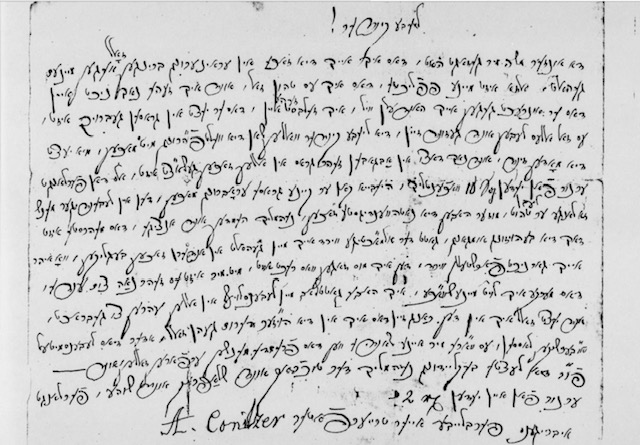
Letter to the children of Aron Israel Conitzer [3]
About The Author

2 thoughts on “Aron Israel – the first Conitzer”