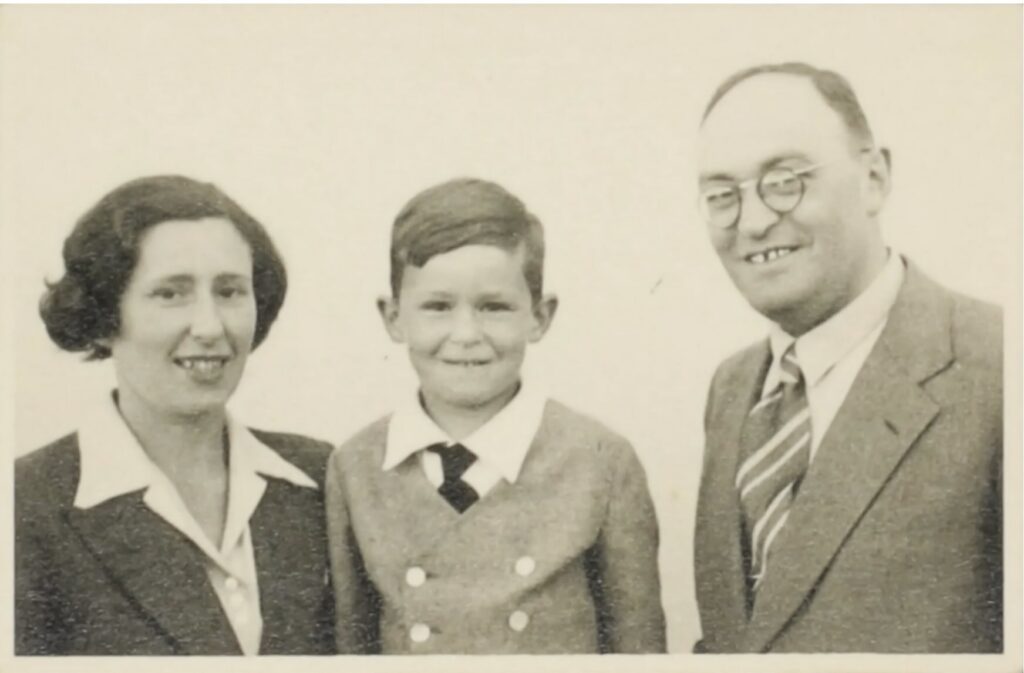
A masterpiece by Erich Eisner
On January 27, 2026, we will travel to Lübeck to attend a concert: Cantata Bolivia by Erich Eisner. I would like to share the reasons why this represents such a special honor for me.
First encounter:
Dr. Töller, who recently published the book M.Conitzer & Söhne,asked me whether the name Erich Eisner sounded familiar to me and whether I had heard about the concert. Honestly, I must confess that I had not. So I googled “Cantata Bolivia” and “Erich Eisner.” Bolivia is my homeland and my heart beats for it—but who was the composer, and why did he compose a work for Bolivia? I had to do some research. Erich Eisner was a musician and conductor who was forced to flee due to National Socialist persecution. Bolivia became his refuge. “Just like my grandfather Gerhard Conitzer,” I thought. The work deals with reconciliation and gratitude toward the country that took him in. Yes, I found that very interesting. Bolivia is not mentioned often in Germany—at least not in the past 25 years that I have been living in Hamburg—and the fact that a classical music concert prominently announced “Bolivia,” and not “Bolivien” (as it is usually written in German), gave me pause. I drew a parallel with my grandfather, who made Bolivia his new home and reconciled with Germany. I had already found two points in common that would have been reason enough to immediately look for tickets. But unfortunately, the concert is in Lübeck, an hour from Hamburg, and on a weekday. A bit difficult for our family routine with two parents working full-time. What a pity—but you can’t dance at every party. So I decided not to go and wished Dr. Töller an enjoyable concert.
Second encounter:
The topic kept following me. Over the weekend we visited the Jewish Museum in Berlin, and my husband came across the story of Erich Eisner on a large screen. He was interested to see that Eisner had also been in Bolivia and asked me whether I knew him. I said yes, that I had even read about him recently. I replied with less enthusiasm than he showed: “Erich Eisner was a great composer and the founder of the Bolivian National Symphony Orchestra.” I didn’t think it was such a coincidence, considering that between 1939 and 1941 between 8,000 and 20,000 European Jews found refuge in Bolivia. Erich Eisner’s son, Manfred Eisner, made a major donation to the Jewish Museum, including the “Cantata Bolivia”. A few clicks on the screen and… yes, Bolivia—yes, I already knew the story. So I kept walking without much interest. My feet were burning after four hours of walking, it was three in the afternoon, we still hadn’t had lunch, and my daughter was already complaining, claiming she knew the museum by heart (which I doubt—but in any case, we needed to eat). We went to the museum restaurant, which unfortunately is on the other side of the building. I passed by so much knowledge that I would have liked to absorb immediately. But well—I’ll come back.
During the break, my husband searched for “Conitzer” on the Jewish Museum’s website; it couldn’t be that there was nothing about the family in the entire museum, considering that the Conitzer family once owned 28 department stores throughout Germany (Brandenburg, Osnabrück, Coburg, Rathenow, etc.). Maybe there was something in the archive. And indeed, he found a result. Connected to Cantata Bolivia, my grandmother’s name appeared: Yolanda Bedregal de Conitzer. I then assumed that she must have written the text. Cantata Bolivia—now it sounded familiar. I had heard the name before. Mystery solved! She wrote the text. Period. What more is there to ask? My grandmother was a poet and writer, became very famous, and was even called “Yolanda of Bolivia.” But I was still missing the link: my grandmother must have known Erich Eisner. At the very least, they must have met once for him to commission the text. Very interesting. Still, we continued to find nothing about my paternal “Conitzer” branch in the museum. A bit sadly, I resumed the tour where I had left off. Later, I kept thinking about how that might be changed someday…
What I didn’t know: despite everything, my husband wrote to Manfred Eisner asking the obvious question. I said to him, “What did you wrote? Do you have a copy?” He said no, but summarized for me the content: “My wife, Valentina Holt (née Conitzer), lives in Hamburg and is the granddaughter of Yolanda Bedregal.” I thought, “Okay, let’s see what happens.” Manfred is already 90 years old and probably won’t reply. I was thinking: “Sven has wasted his time again. All of this is obvious and perhaps nothing special. Why does he need confirmation? I can ask my cousins where to find the cantata text to read it.” Still, by now I was more interested than before. Now I really wanted to attend the concert and read what my grandmother had written. Yet I continued to think that the greatness of the work was mainly due to Erich Eisner’s composition.
Synchronicities:
There were already enough reasons to attend the concert—but things got even better. Manfred Eisner replied very quickly, sent all the information about the concert, and attached my grandmother’s
text . We joyfully received the confirmation that my grandparents were friends of the Eisner family in Sucre. And that’s when we learned that the premiere, originally planned for 1943, never took place. It was meant to be performed for a president in Sucre, but he was overthrown two years later, as was customary in Bolivia. The cantata premiered first in Israel in 2003 and only in 2004 in Bolivia. Incredible! So late? Why? And now it will have its premiere in Germany. Simply wow! That makes it even more special. The cantata, for the first time in Germany—I definitely want to be there. That very evening, I wrote to Dr. Töller telling her that I would attend the concert and how incredible I found all these connections. I added that Manfred had met my aunt and my father at the premiere in 2004. I informed my family immediately and learned that my aunt Rosángela Echazú (Connie) had organized a reception for Manfred at that time. My aunt was a person of enormous energy who did everything with passion and perfection; I can easily imagine how warm the welcome must have been in her large house. Sadly, she passed away recently, but we remember her with great affection.
And there’s more: Do you think that’s all? Not at all. Manfred wrote to me and refreshed my memory: in fact, we had already met in 2005 at his home in Brokdorf! I was there—according to his memory, I showed up spontaneously one sunny afternoon with my brother Cristian. My aunt Connie had told him that we lived in Hamburg. Brokdorf isn’t far away, on the banks of the Elbe. I lost contact and had completely forgotten about it. I’m very sorry for that.
That same evening, we watched an interview with Manfred Eisner recorded by the Jewish Museum Manfred recounts his life and the odyssey of his family history. As he says, after 50 years of unsuccessful attempts, he has finally managed to have his father’s work publicly recognized in Germany. His story—that of a child who went into exile and now lives in Brokdorf—is incredible; we were glued to YouTube for an hour and a half. Now that I know the full story, I value the cantata even more. Manfred is also the author of the book “Verhasst–Geliebtes Deutschland” (Hated–Beloved Germany), which my husband immediately ordered to surprise me. Once again, we realized how small the world is.
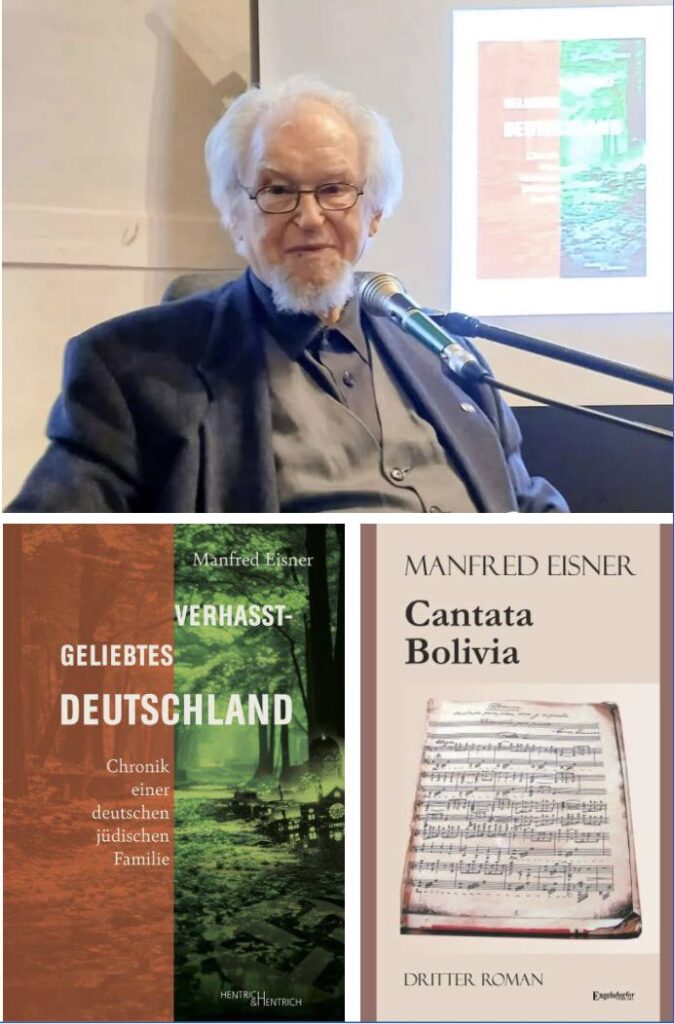
Manfred Eisner and his books
Manfred is happy to have finally realized this project with the support of a group of cultural promoters and democrats committed to fighting the resurgence of National Socialism and preserving the memory of the victims of the Holocaust. He writes: “It is the crowning achievement of the greatest goal of my life.” I congratulate him on his success! It is a magnificent achievement, and I find it beautiful that through it he honors his parents, the Bolivian people, and my grandmother. A truly wonderful reason to celebrate. I now deeply appreciate his commitment and his stories, and I am very happy to be present at the German premiere of Cantata Bolivia.
By the way, admission is free. You are warmly invited!
Would you like to attend? Here are the details:
- When: Tuesday, January 27, 2026, 6:00 p.m.
- Where: Lübeck Cathedral (Dom zu Lübeck)
- Works by: Erich “Erck” Eisner
- Text: Based on a poem by Yolanda Bedregal de Conitzer
- Participants: Schleswig-Holstein Youth Choir; Nina Petri, Stella Motina, Genevieve Tschumi, Gevorg Aperants, Bruno Vargas; Jewish Chamber Orchestra Hamburg (Conductor: Emanuel Meshvinski)
About The Author

Soy admirador de la poesía de Yolanda Bedregal.
cómo puedo oír del concierto?
Saludos desde Bolivia.
Muchas gracias