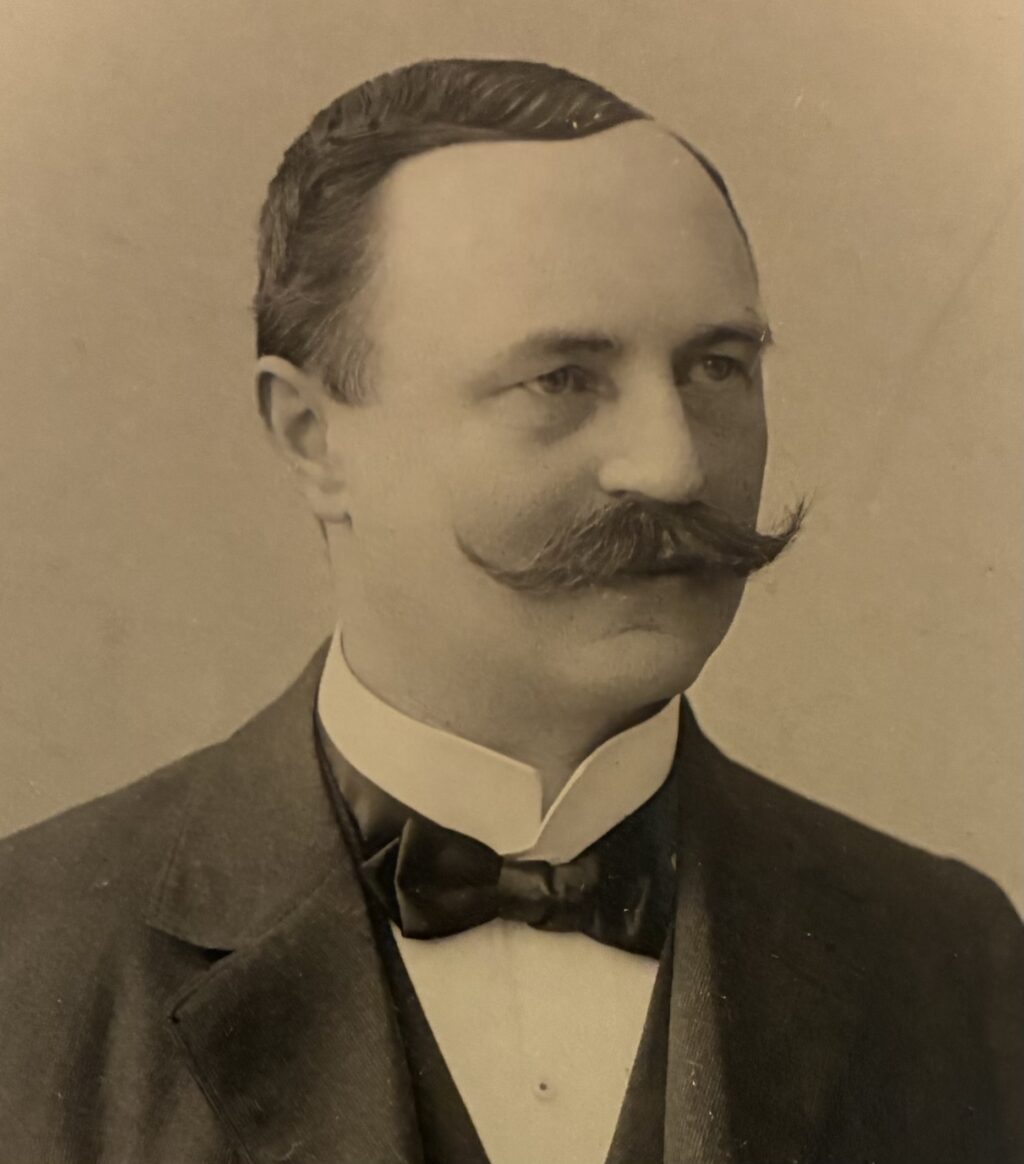
On May 14, 1914, the West Prussian newspaper “Die Presse” from Thorn noted that Count Schwanenfeld-Schwerin and the merchant Rudolf Conitzer would bear part of the costs for the Laskowitz-Schwetz light railway project [2]. The department store owner and the estate owner, or the merchant and the nobleman, wanted to jointly finance a railway for the town of Schwetz in West Prussia. At this time, Rudolf Conitzer was 63 years old, owner of several department stores, and a member of the district council in Schwetz.
At the suggestion of Count von Schwanenfeld-Schwerin of Sartowitz, the light railway project is being redesigned. The resulting costs will be largely borne by Count Schwanenfeld and merchant Rudolf Conitzer.
Quote from the newspaper “Die Presse, Ostmärkische Tageszeitung, Thorner Presse” published on May 14, 1914, see [2]
Rudolf Conitzer was born on May 8, 1851, in Jeschewo, a small village in West Prussia. His father Moses Conitzer and his mother Ernestine Bennheim had just married. They named him Robert. However, he lost his name to the opera “Robert the Devil” by Giacomo Meyerbeer [4]. After his mother saw the opera, his name became Rudolf. Since there was no secondary school in Jeschewo, he first went to Tuchel to attend a private Jewish school with his cousins Louis Jakob1 and Hermann Tuchler. He lived with an uncle. Later, he moved to Schwetz to live with another uncle and attended the Bürgerschule (middle school) there.
At the age of 13, he was consecrated2 and thus became an adult. He left Jeschewo and went to Hohensalza (Polish: Inowrocław) to apprentice with the merchant Jacobsohn. One of the owners called him a “commercial bird” (Kommerzienvogel). He lasted four weeks with Jacobsohn before returning to his parents in Jeschewo. They desperately needed his help in the family shop, Rudolf Conitzer wrote in his biography [1], which is why he had to break off his apprenticeship. But in those four weeks of apprenticeship, he had acquired enough knowledge to reorganize his father’s shop according to the latest commercial principles.
His father, Moses Conitzer, was now his master—or perhaps Rudolf was his own. In any case, Rudolf was given more and more responsibility by his father and learned the trade of a merchant in his home village of Jeschewo. His father trusted Rudolf, and thus intuitively chose the right training program for his son. Not only did Rudolf reorganize the shop, but he also laid out the orchard according to strict geometric principles and managed the agricultural operation with the farmhand. On the side, he earned money as a “people’s lawyer,” giving advice to those in need—such as a man who no longer got along with his wife and wanted a divorce but could not give up his share of the house. Rudolf advised him to take out debts on the house and not pay them back. He and his wife could then split the proceeds from the foreclosure sale. Rudolf was paid a small percentage of the money. In this way, he slowly built up his fortune. Later, he dedicated himself to recruiting Polish labor for the heartland of the German Empire. The exact circumstances can be read in his autobiography [1].
After 27 years, he had reorganized and built up enough for his father and was able to move 13 kilometers away to Schwetz (Polish: Świecie) in 1878 to open his own business with his own money, named Kaufhaus Rud. Conitzer. Just like the department store in Marienwerder, which would be founded four years later by his father and brothers, he relied on fixed prices and cash payment. His brothers Nathan and Alexander would later build on Rudolf’s experience and open the first M. Conitzer & Söhne department store in Marienwerder with their father Moses. Rudolf helped them primarily with advice; for example, he chose the location for the first store and negotiated the lease.
In his department store, he initially employed one clerk and one apprentice. In addition, his sister Rahel helped out in the shop and the household, which also included his younger brother Lothar, who attended the gymnasium in Schwetz to become a doctor. His department store did well, and he had to hire more and more staff. At that time, staff were fed at the employer’s home, and Rudolf realized he urgently needed to marry. His house needed to be better organized and managed. After his first engagement fell through, several people recommended the daughter of the grain merchant Dobrynski to Rudolf. Rosa Dobrynski and Rudolf married in 1880 and had two children, Alfred and Käthe. His department store continued to grow, and after 36 years and 11 renovations, the store had central heating, 12 display windows, an atrium in the center, and a lighting system. Kaufhaus Rud. Conitzer employed 40 people and was the largest in the area. He even had time to travel and spent a vacation with his wife in Egypt.
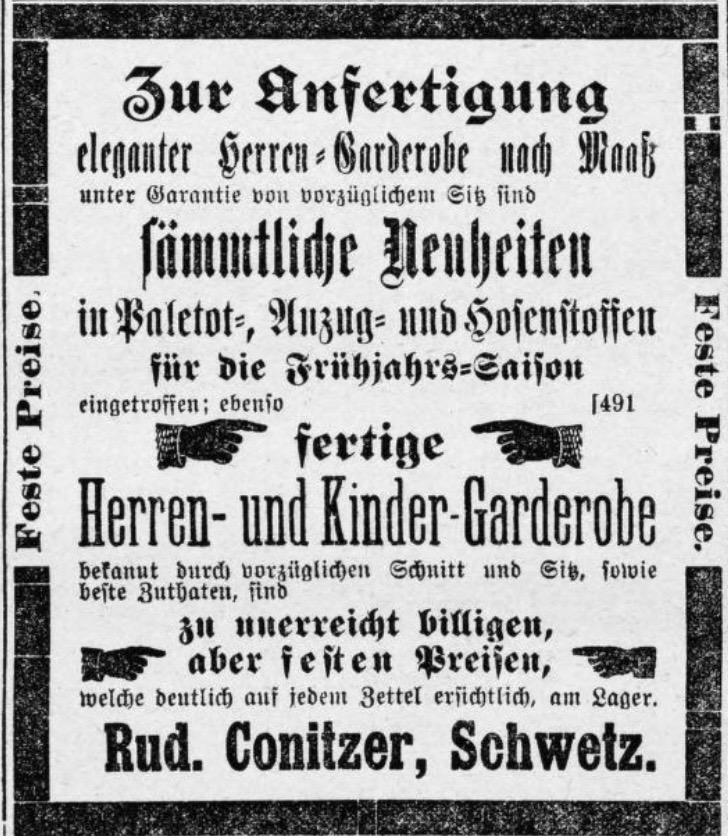
Rud. Conitzer [Advertisement], in: Der Gesellige: Graudenzer Zeitung, March 14, 1897
When Rudolf opened his department store, the German Empire was in a period of economic boom. Industrialization was taking hold. In 1878, about 6,000 people lived in Schwetz [7], both Poles and Germans. However, it lay outside the centers of growth like the Ruhr area or Silesia, as there was very little in Schwetz that directly aided industrialization. There was no coal, no iron ore, or other interesting raw materials. There was agriculture, especially sugar beets. Consequently, a sugar factory was founded in Schwetz, and Rudolf Conitzer was a shareholder in it [1]. Additionally, the railway came to Schwetz in 1888. The residents of Schwetz and the surrounding area wanted to experience the changes of modernity in their daily lives—for example, by wearing the latest fashions from the metropolises of Berlin or Paris—so the department store ran well and could be expanded repeatedly.
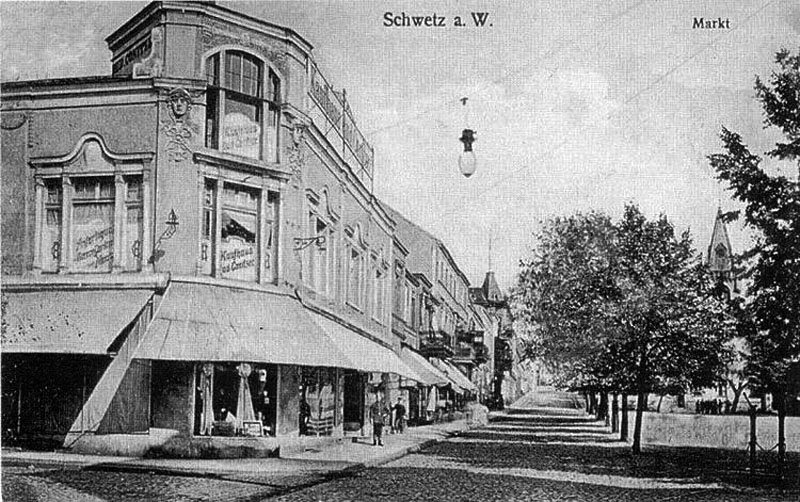
Kaufhaus Rud. Conitzer in Schwetz, Source: Kwidzyn Marienwerder – Łukasz Rzepczyński, Link: https://kwidzyn-muzeum-lukasz.blogspot.com/2012/02/m-conitzer-sohne-cz-4.html
In 1909, Rudolf left Schwetz and moved to Berlin. There, together with his brother Alexander, he was to manage the central purchasing office of the entire Conitzer Group, which included his department store, the M. Conitzer & Söhne stores of his brothers Nathan, Alexander, and Herrmann, and other Conitzer & Co stores belonging to his cousins. The Mayor of Schwetz then asked him to keep a second residence in Schwetz so that he could remain a member of the district council and invest his money in the aforementioned light railway. Additionally, he provided for a city park, a commercial school, and acquired a motorboat for the city that could take people across the Vistula to Culm (Polish: Chełmno) [1]. In 1913, he founded one of the largest branches of M. Conitzer & Söhne in Bromberg (Polish: Bydgoszcz) [1]. His son Alfred was supposed to manage the store, but he had a different plan; he married Erna Struck in Berlin and remained living there.
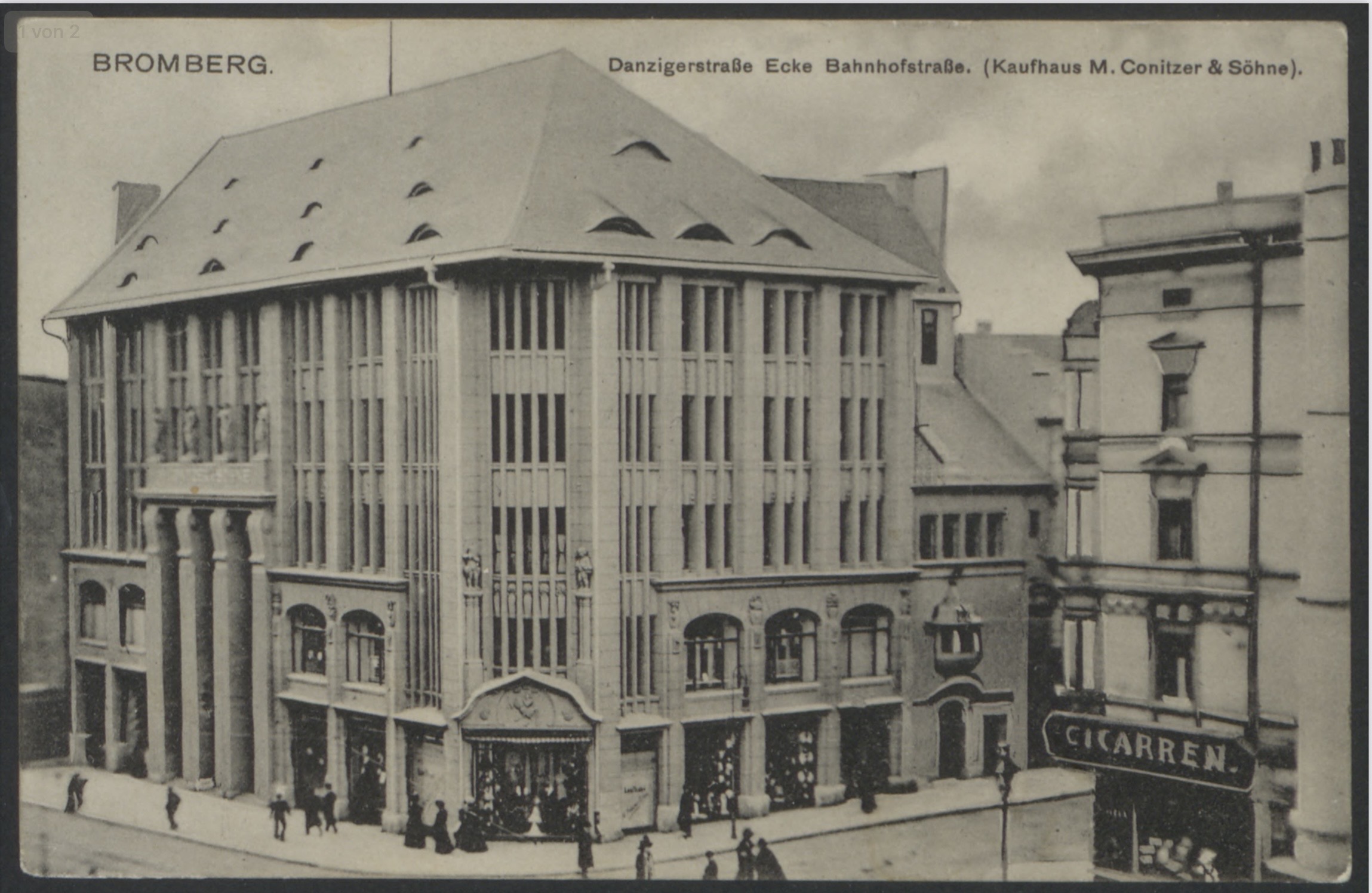
Kaufhaus M. Conitzer & Söhne Bromberg (Polish: Bydgoszcz), Source: archive.org, Link: https://archive.org/details/kpbc.umk.pl.pocz_0008_242655
After the First World War, the department stores in Schwetz and Bromberg were leased out. The latter was handed over to the Polish merchants Chudzinski & Maciejewski [5]. This was because Schwetz and Bromberg became Polish, and it was made impossible for Germans to continue operating businesses in Poland. Rudolf only kept his residence in Berlin. Unfortunately, the Polish merchants were not as successful and terminated the lease agreement a few years later [6]. Thus, in 1929, he had to sell the department store in Schwetz for one-third of its value [1]. His beloved wife Rosa had unfortunately passed away in 1919. Rudolf lived alone in Berlin near his children and three grandchildren. Economically, he participated in further foundations of M. Conitzer & Söhne in Friedrichshagen and in the acquisition of the department store in Hildesheim. He remained active in a leading role in the purchasing company, Webwaren AG in Berlin. Rudolf Conitzer died on September 20, 1932, at the age of 81 in Berlin. He is buried with his wife Rosa at the Weissensee Jewish Cemetery in Berlin.
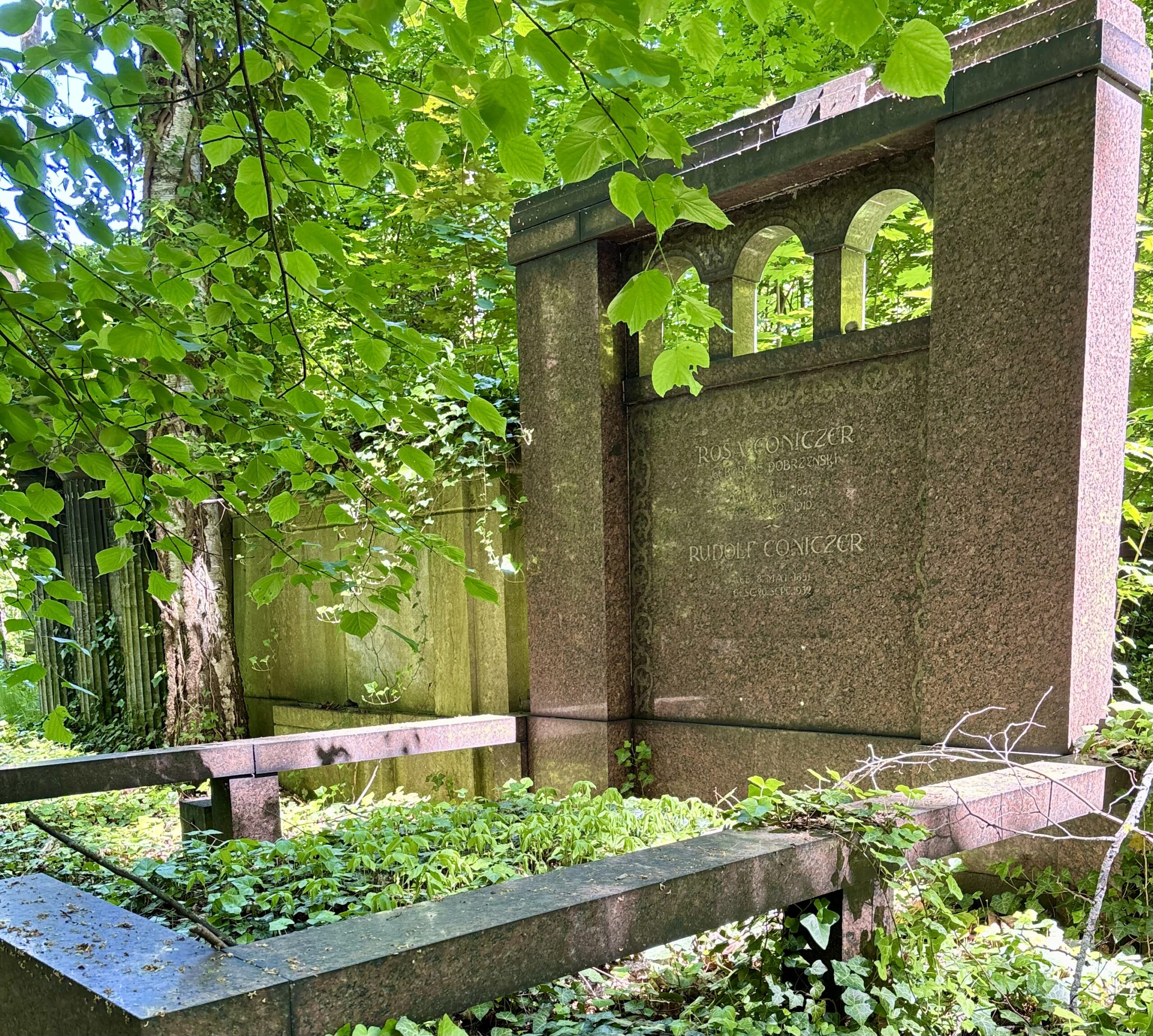
Grave of Rudolf and Rosa Conitzer at the Jewish Cemetery in Berlin Weissensee, Source: Valentina Holt (2025)
The light railway from Schwetz to Laskowitz was never built. Whether Rudolf Conitzer and the Count of Schwanenfeld-Schwerin knew each other personally is unfortunately not recorded. The sons of both men later suffered under the National Socialists. The Count’s son was part of the conspiracy against Hitler that carried out the assassination attempt in 1944, which unfortunately failed. Count Ulrich von Schwanenfeld-Schwerin was executed [8]. The son of the Jewish merchant, Alfred Conitzer, fled from the National Socialists to Bolivia in 1941.
Rudolf Conitzer left us his memoirs [1], for which he can only be praised. In Schwetz, traces of Rudolf Conitzer can still be found today. The building of the department store still stands.
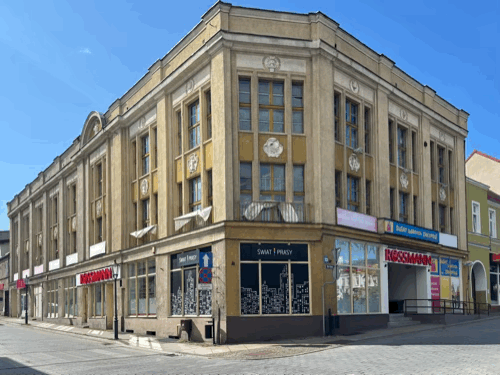
Former Kaufhaus Rud. Conitzer in Schwetz, Source: Valentina Holt (2025)