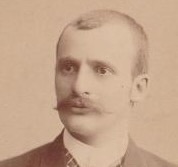
Aron Israel Conitzer | Moses Conitzer | Lothar (Lesser) Conitzer
Tornquiststrasse is now a bicycle street. We ride along it twice a week to take our daughter to gymnastics. Tornquiststrasse crosses Doormannsweg, nowadays a four-lane road. Lothar Conitzer lived at this intersection of Tornquiststrasse and Doormannsweg from 1908 to 1939, when it was not yet an intersection. So, every week, we ride through his living room at least twice.
First steps in life
Lesser (called Lothar) Conitzer was born on February 7, 1865, in Jeschewo (Polish: Jezewo) as the seventh child. Jeschewo is a small village in West Prussia, in what is now Poland. The nearest town is Schwetz on the Vistula (Polish: Swiece). It is about 100 km to Danzig and about 400 km to Berlin. He was the youngest of seven siblings. His grandfather was a merchant and later a teacher. He had achieved modest prosperity and enabled Moses, Lothar’s father, to establish himself as a small-scale merchant in the small village of Jeschewo. All four of Lothar’s brothers became merchants and, together with their father Moses, founded the department store chain M. Conitzer & Söhne in Marienwerder in 1882, which operated 22 department stores in its heyday [7]. One of the merchant brothers is my wife’s great-great-grandfather. Thanks in particular to mutual support within the family, all members were able to build up a certain degree of prosperity, which meant that Lothar Conitzer was the only one in the family who had the opportunity to study medicine in Berlin and Halle. In Berlin, he studied under Prof. Dr. Du Bois Reymond [4], who was one of the “founders of modern physiology as a scientific discipline.” He wrote his doctoral thesis in Halle. It was titled “On the surgical treatment of pleuritic exudates in children, with special consideration of purulent exudates.” [3]
Arrival in Hamburg
In 1892, he was hired at the Jewish Hospital in Hamburg. In 1894, he received his state license to practice medicine and opened a practice on Eppendorfer Weg [1]. He then married Frieda (Rika) in 1900 [2].
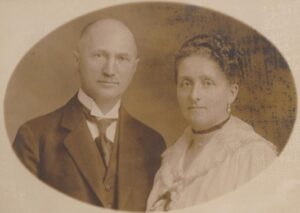
Frieda was adopted as a small child by the Hamburg art dealer Ludwig Lewy and his wife Minna. She grew up in their house at An der Alster 74. The Hotel Atlantic, built in 1909, now stands on that site. Her biological parents died when she was four years old.
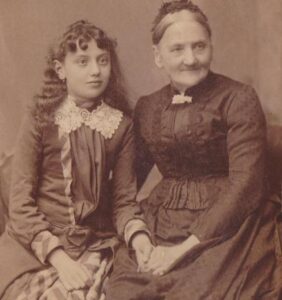
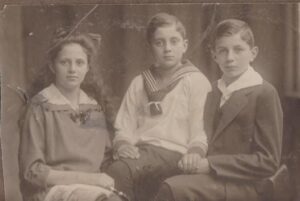
Lothar Conitzer and his wife Frieda (Rika) moved into their own house at Tornquiststrasse 9 in 1908, where they lived with their three children: Ludwig, Margarete, and Manfred.
It was a big house with three floors, central heating, a dumbwaiter, and a wine cellar. The family employed a cook, a maid, a nanny, a receptionist, a gardener, and a chauffeur. The kitchen, pantries, and bathrooms were located on the ground floor. Lothar Conitzer had set up his practice on the first floor. The family lived on the second floor, which also had a salon where large parties were often held, entertaining up to 30 people. Tornquiststrasse 9 was a meeting place for many doctors and academics from Hamburg. His practice was extremely successful: he was able to buy more real estate in Hamburg and some shares in various companies.
Lother Conitzer had established himself in Hamburg. He was a wealthy citizen of the city. Lothar Conitzer loved German painters and had many paintings hanging in his house. He was a philanthropist; his granddaughter wrote about him [5]. During World War I, for example, he treated a young artist and received a painting of his daughter in return. Frieda Conitzer loved opera and could sing a song from a famous opera at any time, even on the slightest occasion. She loved her salon and the parties she could host there.
The escape
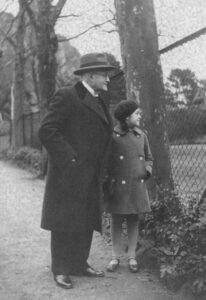
From 1935 onwards, Lothar Conitzer was able to treat fewer and fewer patients. In 1938, changes in the law made it impossible for him to practice as a doctor and he had to close his practice. He sold his houses to Aryans in Hamburg at well below market price. On October 20, 1938, shortly before Kristallnacht, he emigrated to Cape Town, South Africa, where his son Manfred had already fled in 1934. His daughter Margarete fled to Northern Rhodesia, now Zambia, in 1939 with her husband Hans Jacoby and their daughter Annette. His first son Ludwig, also a doctor, had already died in 1929 as a result of an operation to remove a brain tumor. Lothar and Frieda Conitzer arrived in Cape Town penniless. They were dependent on the help of their children. Both died in Cape Town in 1947. Lothar on July 9, 1947, and Frieda on November 27, 1947 [6]. Their granddaughter Annette Stannett wrote about them in her biography “The colors of my life”: “The loving devotion that I sensed between my grandparents, and equally between my parents, made me feel safe and secure when I was young.” [5]
Reparations
Lothar Conitzer died before the Federal Republic of Germany even began to pay reparations. His heirs, Manfred Conitzer and Margarete Jacoby, enforced the claims in the Hanseatic City of Hamburg. The reparations file shows that compensation was paid. The reparations process was not completed until January 1, 1967. The material damage has been compensated. Nevertheless, we are all still struggling today with the immaterial damage caused by the political decisions made in Germany at that time.[6]
Epilogue
Tornquiststrasse 9 no longer exists. Nevertheless, we remember the philanthropist and doctor Lothar Conitzer and his opera-singing wife Frieda twice a week when we drive past their living room again.
About The Author

Lindo trabajo encontrar las raíces con gratitud, mirar el pasado, aprender llenar el corazón y seguir adelante con otra mirada. Felicidades!